
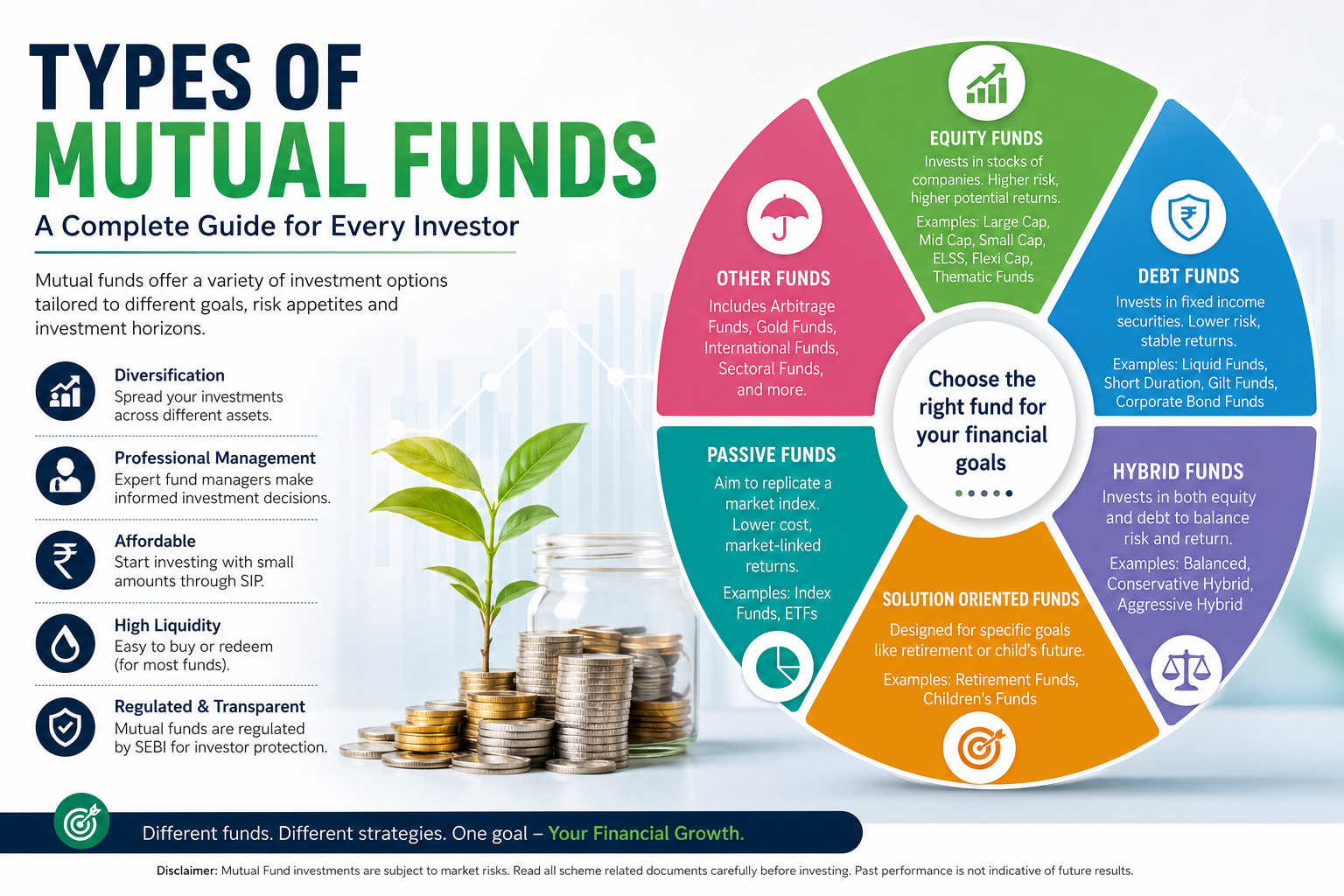
Types of Mutual Funds: A Complete Guide for Every Investor
What is a Mutual Fund?
A mutual fund is an investment vehicle that pools money from multiple investors and invests it in a diversified portfolio of stocks, bonds, gold, or other securities. These investments are managed by professional fund managers who make investment decisions on behalf of investors.
Mutual funds offer diversification, professional management, liquidity, and the convenience of investing with small amounts through a Systematic Investment Plan (SIP).
Types of Mutual Funds Based on Asset Class
1. Equity Mutual Funds
Equity funds invest primarily in shares of listed companies. They aim to generate higher returns over the long term but come with relatively higher market risk.
Types of Equity Funds
Large Cap Funds
Mid Cap Funds
Small Cap Funds
Multi Cap Funds
Flexi Cap Funds
ELSS (Tax Saving Funds)
Sectoral/Thematic Funds
Focused Funds
Value Funds
Contra Funds
Best For:
Long-term wealth creation
Investors with higher risk appetite
Investment horizon of 5 years or more
2. Debt Mutual Funds
Debt funds invest in fixed-income instruments such as government securities, treasury bills, corporate bonds, and money market instruments.
They generally carry lower risk than equity funds and provide relatively stable returns.
Types of Debt Funds
Liquid Funds
Overnight Funds
Ultra Short Duration Funds
Low Duration Funds
Short Duration Funds
Medium Duration Funds
Long Duration Funds
Corporate Bond Funds
Banking & PSU Funds
Gilt Funds
Dynamic Bond Funds
Credit Risk Funds
Best For:
Capital preservation
Emergency funds
Short to medium-term goals
3. Hybrid Mutual Funds
Hybrid funds invest in a combination of equity and debt instruments to balance risk and return.
Types of Hybrid Funds
Conservative Hybrid Fund
Balanced Hybrid Fund
Aggressive Hybrid Fund
Dynamic Asset Allocation Fund
Multi Asset Allocation Fund
Arbitrage Fund
Equity Savings Fund
Best For:
Investors seeking balanced growth
Moderate risk tolerance
First-time investors
Types of Mutual Funds Based on Investment Objective
Growth Funds
Designed to generate long-term capital appreciation by investing mainly in equities.
Suitable for: Long-term investors.
Income Funds
Focus on generating regular income through investments in fixed-income securities.
Suitable for: Retirees and conservative investors.
Tax Saving Funds (ELSS)
Equity Linked Savings Schemes (ELSS) offer tax deductions under applicable income tax provisions while investing primarily in equities.
Lock-in Period: 3 years
Suitable for: Tax-saving and wealth creation.
Retirement Funds
These funds help investors accumulate wealth for retirement and often have a lock-in period.
Children's Funds
Designed to meet future financial goals like education or marriage.
Types of Mutual Funds Based on Structure
Open-Ended Mutual Funds
Can be purchased or redeemed anytime.
Highly liquid.
Most popular category.
Close-Ended Mutual Funds
Investment allowed only during the New Fund Offer (NFO).
Fixed maturity period.
Units are generally listed on stock exchanges.
Interval Funds
Operate as a combination of open-ended and close-ended funds, allowing purchases and redemptions during specified intervals.
Types of Mutual Funds Based on Risk
Low Risk Funds
Liquid Funds
Overnight Funds
Money Market Funds
Moderate Risk Funds
Hybrid Funds
Corporate Bond Funds
Banking & PSU Funds
High Risk Funds
Small Cap Funds
Mid Cap Funds
Sectoral Funds
Thematic Funds
Types of Mutual Funds Based on Market Capitalization
Large Cap Funds
Invest in India's largest companies with stable business models.
Risk: Moderate
Mid Cap Funds
Invest in medium-sized companies with higher growth potential.
Risk: High
Small Cap Funds
Invest in emerging businesses offering significant growth opportunities.
Risk: Very High
Multi Cap Funds
Invest across large, mid, and small-cap companies with mandatory allocation requirements.
Flexi Cap Funds
Offer flexibility to invest across market capitalizations based on market opportunities.
Passive Mutual Funds
Passive funds aim to replicate the performance of a benchmark index instead of trying to outperform it.
Types
Index Funds
Exchange Traded Funds (ETFs)
Benefits
Lower expense ratio
Transparent investment strategy
Suitable for long-term investing
Solution-Oriented Mutual Funds
These funds are designed for specific financial goals.
Examples include:
Retirement Funds
Children's Gift Funds
Most have a mandatory lock-in period.
Which Mutual Fund Should You Choose?
The right mutual fund depends on your financial goals, investment horizon, and risk tolerance.
Financial Goal | Recommended Mutual Fund |
|---|---|
Wealth Creation | Equity Funds |
Emergency Fund | Liquid Funds |
Regular Income | Debt Funds |
Tax Saving | ELSS |
Retirement Planning | Retirement Funds |
Balanced Investment | Hybrid Funds |
Child Education | Children's Funds |
Benefits of Investing in Mutual Funds
Professional fund management
Diversified portfolio
Affordable investment through SIP
High liquidity (for most funds)
Suitable for all types of investors
Regulated by SEBI
Multiple investment options based on financial goals
Final Thoughts
Mutual funds are versatile investment products that cater to different financial goals, risk appetites, and investment horizons. Whether you're looking to grow your wealth, save taxes, generate regular income, or plan for retirement, there's likely a mutual fund that fits your needs.
Before investing, assess your financial objectives, understand the risks involved, and choose funds that align with your long-term strategy. If you're unsure, consult a qualified financial advisor to create a portfolio tailored to your goals.
Disclaimer: Mutual Fund investments are subject to market risks. Read all scheme-related documents carefully before investing. Past performance is not indicative of future results.
Recent Posts
-
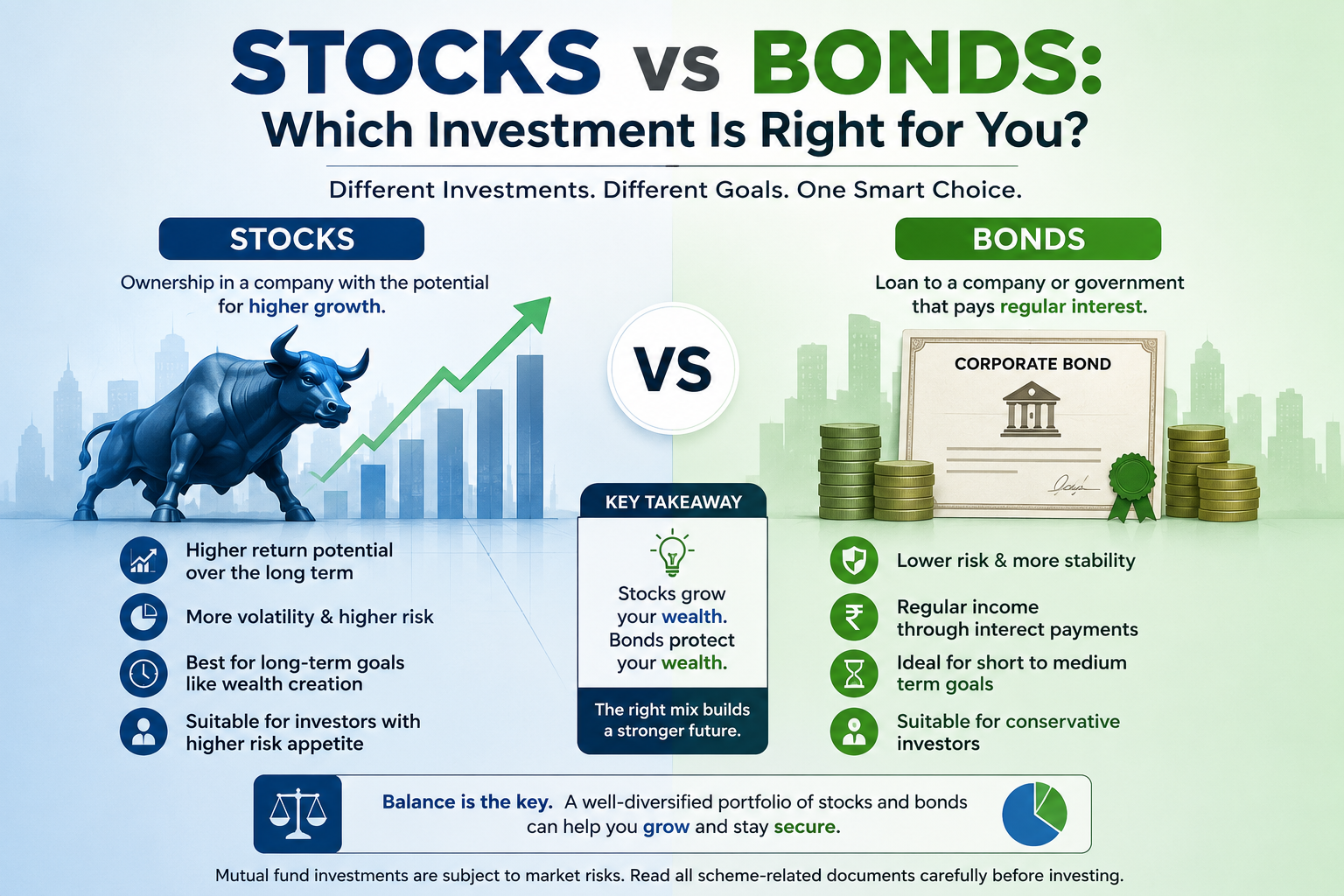
Stocks vs Bonds: Which Investment Is Right for You?
22 Jul, 2026 -
-

-

-

-

-

-

SIP vs Lumpsum: Which Is Better and When?
17 Jan, 2026 -

-

-

-

Difference Between SIP and Mutual Fund
08 Dec, 2025 -

-

Your Financial Goals Deserve Expert Guidance
Whether you're planning investments, securing retirement, or expanding your business — Larren Square helps you make smarter, well-informed decisions.